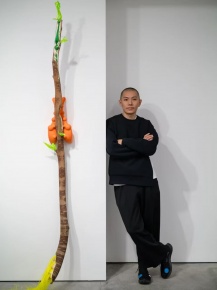
Conversation | Melting Wang: Coexisting with the "Uncontrollable"
Q
A
: Why did you choose “种瓜得豆 (zhòng guā dé dòu, meaning ‘Planting Melons and Reaping Beans’) ” as the title for this exhibition? It sounds related to plants and land, yet also subtly carries an illogical, experience-defying connotation. How did you arrive at it?
Wang Melting:
I was quite pleased to land on this title myself, as much of my work actually discusses the contemporary technological environment while incorporating the elements of plants and land you mentioned. At the same time, I hoped this title could reflect my own creative environment and bodily experience.
The phrase “you reap what you sow” (in Chinese: “planting melons and reaping melons, planting beans and reaping beans”) is something we\\\'ve been familiar with since childhood. It contains a perception of natural laws and is also a very linear causal experience. But this kind of experience isn\\\'t entirely the same as what we face in the current technological discourse dominated by artificial intelligence. Recently, I\\\'ve listened to quite a few podcasts on science and technology, and often hear this notion that technology itself is “uncontrollable.” Research into AI is more like planting a seed—you\\\'re not sure what you\\\'ll ultimately harvest; it needs time to slowly reveal its outcomes.
This is actually quite close to my own creative process. Often, most of the initial time is spent experimenting with various ideas amid uncertainty; things fail as I work, and then I start over. But these attempts themselves are like seeds I\\\'ve sown. It\\\'s only in the final stages that a relatively clear direction slowly emerges.
Additionally, my studio is in a semi-outdoor farmhouse courtyard. Working under such conditions has gotten me into the habit of checking the weather forecast. For instance, when it rains, I can\\\'t spray paint, and many painting works must wait for dry weather to continue. This way of working alongside nature constantly reminds me of land and farming experience. And simultaneously, we are facing a larger technological environment, needing to think about how the individual coexists with it. I feel the title “种瓜得豆 (zhòng guā dé dòu, meaning ‘Planting Melons and Reaping Beans’) ” aptly connects these layers together.
: You didn\\\'t opt for a direct translation of the exhibition\\\'s English title, instead using \\\"Organic Digital.\\\" I sense that, while harboring an interest in digital aesthetics, you still want the works to possess physicality and weight. This balance also seems to exist in your life and the studio environment you just mentioned.
Wang Melting:
I think the direction of technological development is actually moving toward a state closer to nature, or more organic—as if the outline of technological development increasingly resembles life itself. I feel this trend quite distinctly. For me, rather than moving forward with technology, it\\\'s more like I\\\'m searching backward from this trend for a certain state. Perhaps some of our earlier bodily experiences have been overlooked or overly negated when discussing technology and the future. So now I\\\'m focusing more on returning attention to perception itself, feeling things slowly and carefully.
I was born in a grassland town and have had a very direct perception of those relatively primal environments since childhood. I\\\'m also well aware that in those so-called purely primal environments, my own state of existence wasn\\\'t actually comfortable. But being completely surrounded by technology isn\\\'t what I want either, because both my creative work and life are inseparable from the perceptual dimension of the physical body. I feel that only when works and life can establish a connection with bodily sensation do I gain a sense of security.
: I\\\'ve noticed recurring digital elements in your works, like routers, controllers, LED fans, lenticular sheets, etc., rather than the cutting-edge high-tech people focus on now. Why do you continuously pay attention to this type of object?
Wang Melting:
I am interested in technology itself, but I\\\'m not a so-called “geek” nor a tech worker; I haven\\\'t entered a very deep, professional level. Much of my creation is actually based more on everyday perception. Whether it\\\'s the experience of playing games or daily contact with routers and various signals, they are all very tangible things for me.
I feel these objects often exist in a relatively early and basic state within the current technological logic, yet they are the most direct points of contact between our bodies and technology. For me, these fundamental technological objects themselves form a kind of stimulus, sparking the desire to continue thinking and expressing.
I deliberately choose objects like routers, LED fans, solder, lenticular stickers—items closer to the “infrastructure” level of technology—and amplify their properties as mediums in the works. Simultaneously, on the viewing level, they also provide a relatively direct, accessible entry point for the audience.
Specifically regarding game controllers, for me, it\\\'s more of a body-related object. Game controllers are themselves a bionic structure, mimicking the gripping posture of the human hand in form—a very clear bodily interface. Therefore, when using it, I focus more on how it serves as a medium connecting bodily movement with technological systems.
The inspiration for lenticular stickers originally came from the code of the digital world in The Matrix. During a casual observation, I noticed these constantly shifting \\\"0\\\"s and \\\"1\\\"s looked like pairs of little eyes, as if the most basic elements of these programming languages themselves possessed a certain sense of life, capable of conversing with our real world.
: In Welcome Stone, you also achieved the simplest lenticular effect in a lower-tech, more analog way, generating changes through the viewer\\\'s shifting gaze. How did you come to handle it this way?
Wang Melting:
The starting point for the Welcome Stone series actually stems from a long-standing interest of mine: what things do we judge as \\\"natural objects\\\"? For example, a stone—if we can\\\'t identify any information or specific shape on it, it\\\'s usually considered a natural thing; but if we carve characters onto it, it becomes artificial again. So when I first started making Welcome Stone, I was thinking about whether I could treat it into a more ambiguous state, a coexistent state of \\\"both/and.\\\" And \\\"welcome stones\\\"—the act of \\\"welcoming\\\" itself carries a sense of \\\"responding.\\\"
A few years ago, visiting the Galileo Museum, I saw an exhibition hall displaying the early sprouts of science during the Renaissance. There was a medieval family painting that used a corrugated-like structure to depict two figures on the same surface: viewed straight on, it was a portrait of the male head; from another angle, it would transform into the female head. I realized then that this was actually an early lenticular structure. Looking back now, this experience also served as an inspiration for the Welcome Stone sculptures.
: In your other works, one can also see your interest in the relationship between natural and man-made objects. You combine found earth, wood from nature with digital components and tools. Why juxtapose these two seemingly unrelated types of materials?
Wang Melting: This question actually goes back to a point we discussed earlier: the issue of how the individual coexists with a larger technological environment. When I, as an individual, feel changes in the surrounding macro-environment, I imagine myself as a small object, a sensor, or a microorganism. I\\\\\\\\\\\\\\\'m simply receiving information, sensing the environment changing around me. At such moments, my first thought isn\\\\\\\\\\\\\\\'t to change anything, but rather to adjust myself first, or to mutually adjust with the things I can directly touch. Combining man-made objects with natural materials like earth and wood is, from a creative perspective, an attempt to achieve such a state of balance.